
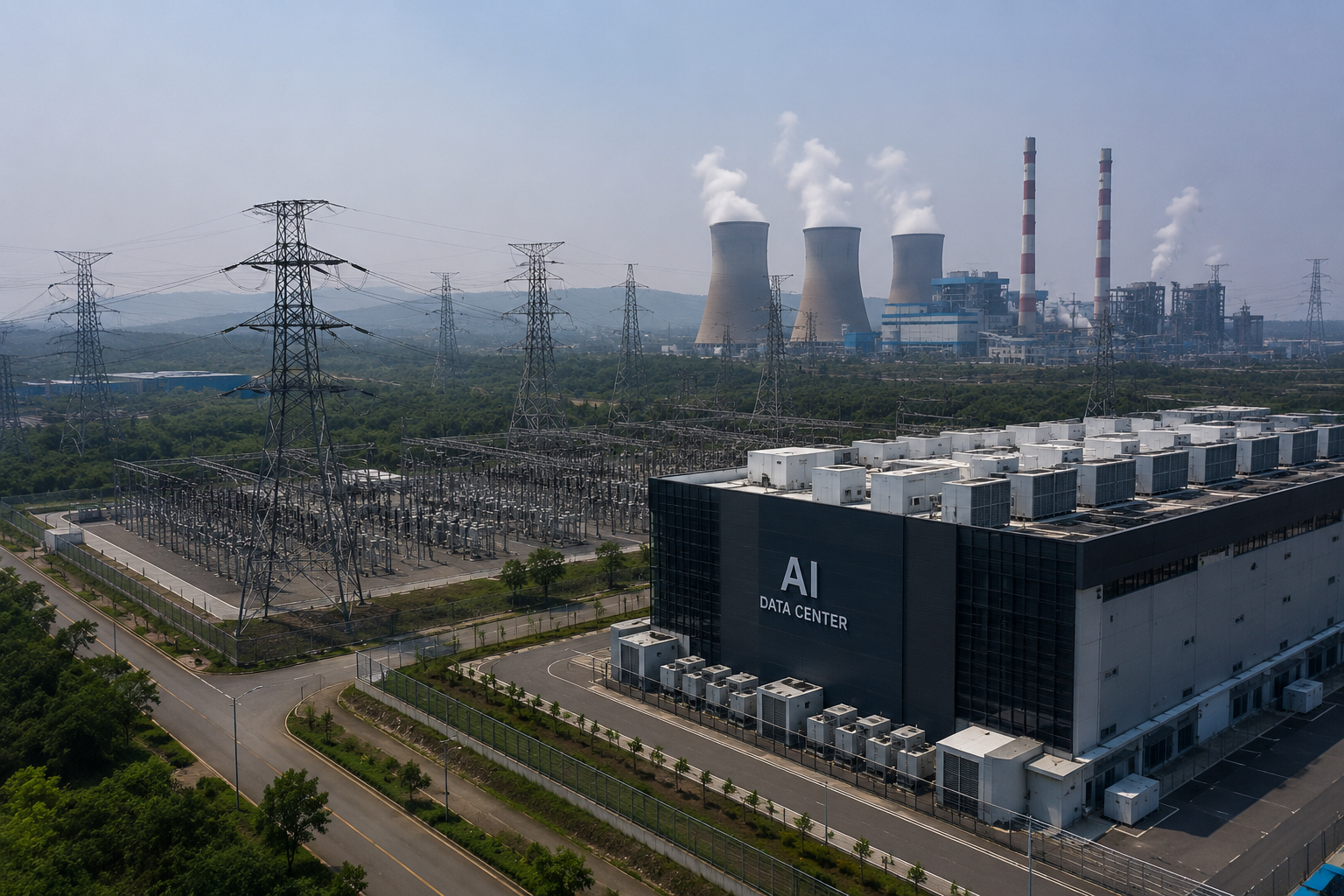
India’s energy sector is at a unique juncture.
Heatwaves are increasing power consumption across the grid, and hyperscalers are trying to build AI data centers in the country.
Are these twin pillars of demand going to help the power companies in the country? Especially when power companies are seen as a proxy for an AI play in India?
The market currently thinks so. The Nifty Energy index has gained 11% so far this year, outperforming the broader market.
The benchmark Nifty 50 index has fallen 8.3% in the same period.
Some analysts argue that the power companies have run far ahead of their valuations, while others say it is justified due to future earnings potential.
Rising electricity demand due to AI boom and weather conditions
India is expected to attract huge investments in building the power infrastructure in the country.
The Central Electricity Authority (CEA) has pointed out that India will attract ₹7.9 trillion in transmission investments through 2035-36.
This investment has been driven by the rising power demand in the country.
Power consumption increased to 164.98 billion units (BU) in May and 166.46 BU in June, both growing by 11% from the previous year’s figures.
Heatwaves and delayed monsoon have added to the power consumption.
Adding more pressure on demand is hyperscalers racing to establish AI and cloud infrastructure in the country.
In June, Amazon committed an additional $13 billion to expand its AI and cloud infrastructure in the country, taking its planned investments in India to $48 billion between 2026 and 2030.
The new funding will expand data centre capacity in Mumbai and Hyderabad.
The move follows a string of large commitments from global technology firms.
Amazon had already pledged $35 billion last year, while Microsoft earmarked $17.5 billion.
Alphabet-owned Google also announced plans to invest $15 billion over five years to expand data-centre capacity in southern India.
The growth has significant implications for electricity demand.
S&P Global Commodity Insights estimates that Indian data centres consumed about 13 TWh of electricity at the end of 2024, equivalent to roughly 0.8% of the country’s total power demand.
Data-centre electricity demand is projected to rise almost fivefold to 57 TWh by 2030, growing at an average annual rate of about 28%.
Data centres’ share of India’s electricity consumption is expected to more than triple to around 2.6% by 2030.
S&P Global Commodity Insights also expects India to become the second-largest market for data-centre electricity demand in Asia-Pacific within the next two years, overtaking Japan and Australia.
Power stocks soar, analysts divided on valuations
While companies in the power sector have outperformed the broader Indian markets, analysts are divided on their future prospects.
Jahol Prajapati, Equity Research analyst at SAMCO Securities, told Invezz: “AI-driven data centres are undoubtedly a long-term demand catalyst for India’s power sector, but the market appears to be pricing in this opportunity much faster than earnings are likely to materialise.”
“The near-term revenue impact on utilities remains modest,” he said, adding that many power stocks have re-rated on expectations rather than current cash flows.
Instead, he believes the biggest beneficiaries could be companies supplying equipment to the grid.
“The strongest pricing power lies with grid equipment manufacturers, particularly high-voltage transformers and switchgear,” Prajapati said, citing global supply shortages, lead times of more than 24 months, and premium pricing that support margins.
He added that AI data centres also change the nature of electricity demand.
“Residential demand is seasonal and evening-peaking, while AI data centres require steady 24×7 baseload power,” he said.
According to Prajapati, meeting that demand will require round-the-clock renewable power backed by storage, stronger transmission infrastructure, and flexible thermal generation.
Siddarth Bhamre, Head- Institutional Research, Asit C Mehta, on the other hand, said just because a sector has performed well doesn’t mean it lacks future growth prospects.
Bhamre told Invezz that power stocks are more of an ancillary trade rather than a proxy trade.
“Investors often look beyond FY28 to FY29 and FY30 to see how value can be captured or discounted today. So it’s not just about the near-term earnings. Sometimes market participants discount long-term earnings today if the probability of earnings visibility is high,” he added.
The expert prefers transmission companies within the power segment, followed by equipment manufacturing and power generation.
Grid expansion remains key
India has been adding power infrastructure as power demand has climbed.
According to Ankit Jain, Vice President and Co-Group Head for Corporate Ratings at ICRA, electricity demand rose 7.1% year-on-year during the first two months of FY2027, while peak demand touched around 271 GW in May 2026, up from 245 GW in FY2026.
India added around 62 GW of generation capacity in FY2026 and is expected to add another 50 GW this fiscal year, largely through renewable energy, Jain said.
He noted that average thermal plant load factors (PLFs) stood at 65.2% in FY2026 but could improve as demand rebounds. “PLF levels of 65-67% denote headroom available for ramp-up to meet additional demand,” Jain said.
Battery storage is also expected to play a larger role, with more than 22 GWh of standalone battery energy storage tenders awarded in FY2026.
These projects could be installed within 12 to 18 months and help support peak electricity demand.
Jain also expects transmission companies to enter a capital expenditure cycle as renewable capacity expands. However, he warned that timely execution remains critical.
“Transmission projects have historically faced delays due to execution-related challenges,” Jain said. “A timely commissioning of transmission infrastructure remains critical for evacuating future renewable energy capacity.”
Equipment makers emerge as early beneficiaries
Investors have increasingly favoured companies supplying equipment needed to modernise the grid.
Transformer and switchgear manufacturers such as Siemens India, ABB India, Hitachi Energy India, Schneider Electric India and BHEL have delivered strong stock market performances in 2026 as expectations for transmission spending gathered pace.
| Company | Order Book Backlog as of March 2026 in ₹ crore | Stock performance YTD | March 2027 P/E (Data from Ambit Capital) |
|---|---|---|---|
| GE Vernova T&D | 21,456 | 33% | 80.7x |
| Siemens Energy India | 18,430 | 27% | 75.6x |
| ABB India | 11,094 | 42% | 84.9x |
| Hitachi Energy India | 29,555.3 | 68% | 109.7x |
| CG Power and Industrial Solutions | 15,719 | 38% | 94x |
| Schneider Electric Infrastructure | 1,911 | 88% | 88.6x |
“If there’s a shortage of transmission and an oversupply of generation, then obviously, the order book of transmission companies would swell more, and it would give clarity to investors.
It would also give clarity to management on whether they want to do capacity expansion or not”, Siddarth Bhamre added.
Among power producers, Adani Green Energy and Adani Power have outperformed peers after the Adani Group unveiled plans to invest $100 billion by 2035 in AI-ready data centres and related infrastructure.
The group’s data-centre business, AdaniConneX, aims to build 5 GW of capacity by 2035.
It is partnering with Google on the technology giant’s planned $15 billion data-centre expansion in India.
Adani founder Gautam Adani is also in discussions with Meta Platforms and Walmart-owned Flipkart for potential partnerships, Bloomberg reported in March.
For now, analysts say the long-term demand story remains intact, but whether current stock prices are justified will depend on how quickly AI-driven electricity consumption translates into higher earnings across India’s power value chain.
The post Adani and other Indian power stocks rally on AI play, but are valuations too high? appeared first on Invezz