
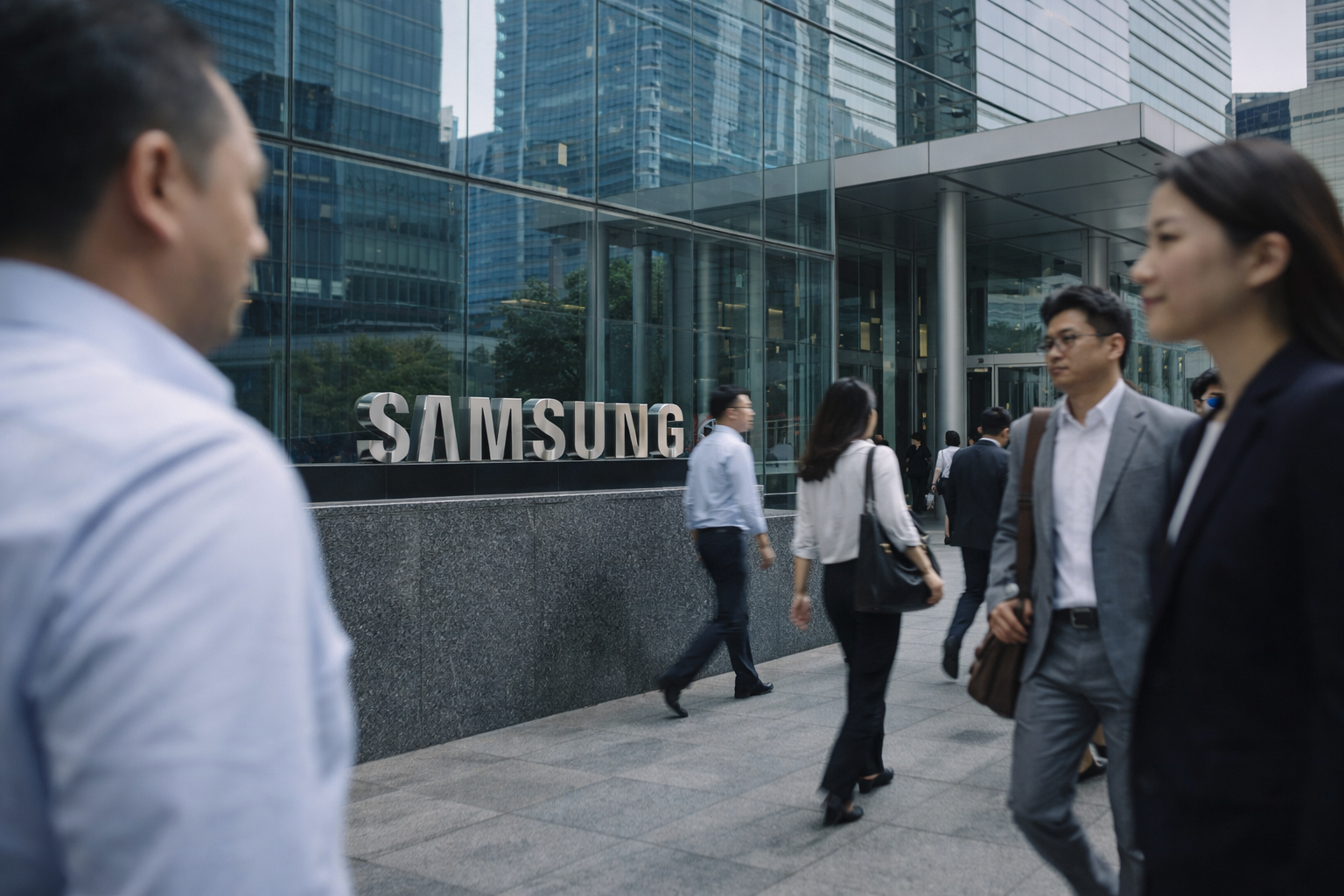
Samsung stock rebounded on Tuesday after Monday’s brutal selloff, giving investors a sharp reminder of how quickly the AI trade can swing from panic to bargain-hunting.
The stock rose as much as about 5% in Seoul, a day after dropping 10.2% as South Korea’s benchmark KOSPI suffered one of its steepest falls in years.
The index plunged 8.3% on Monday, triggering circuit breakers soon after the open, as a global chip rout collided with stronger US jobs data and renewed Middle East tension.
The key question now is whether Monday’s selloff marked a real turning point or simply a buying opportunity for investors.
When the circuit breaker rang
KOSPI fell 8.3% to 7,484.41 on Monday, its biggest daily drop since March 4, after robust US payrolls data revived fears that the Federal Reserve may have to lift rates again.
The selloff followed a rough session for US chip stocks, where the Philadelphia Semiconductor Index had slumped 10.3% after Broadcom’s report raised fresh questions about how much AI optimism was already priced in.
That pressure hit South Korea harder than most markets because the KOSPI has become deeply concentrated in semiconductors.
Samsung and SK Hynix now account for more than half of the benchmark’s market capitalisation. When those two stocks fall together, the index breaks lower.
Samsung dropped 10.2% on Monday, while SK Hynix lost 7.7%. The circuit breaker was the third this year and the ninth in the index’s history, underscoring how stretched the rally had become.
The warning signs were visible before the crash.
BTIG technical strategist Jonathan Krinsky had flagged the risk of a swift downside reversal in chip-heavy markets.
Nothing broke but sentiment
The strongest argument for the bulls is that Monday’s selloff looked more mechanical than fundamental.
Samsung’s earnings story is still powerful as the company reported record first-quarter revenue of 133.9 trillion won and operating profit of 57.2 trillion won, an eightfold jump from a year earlier.
Its semiconductor division generated 53.7 trillion won in operating profit, accounting for almost all of the group’s earnings.
The product cycle also remains intact. Samsung said in late May that it had started shipping samples of its 12-layer HBM4E memory chips to major global customers, calling them an industry first.
The chips are designed for next-generation AI workloads, exactly where investor appetite has been strongest.
Samsung stock: Bulls load up
Tuesday’s rebound suggests investors are not ready to abandon the AI memory trade.
The KOSPI bounced, Samsung recovered part of Monday’s loss, and chip names across Asia drew renewed buying after Wall Street steadied.
Kiwoom Securities analyst Han Ji-young said that earnings momentum remained robust for semiconductor stocks, even as volatility was likely to stay high.
The bigger bull case is still straightforward as AI data centres need more high-bandwidth memory, supply remains tight, and Samsung is trying to close the gap with SK Hynix at the high end of the market.
Goldman Sachs recently upgraded both South Korea and Taiwan, arguing that Asian chip earnings still had room to run despite the risk of a pullback.
The post Samsung rebounds 5% after crash: buy-the-dip moment or warning sign? appeared first on Invezz