
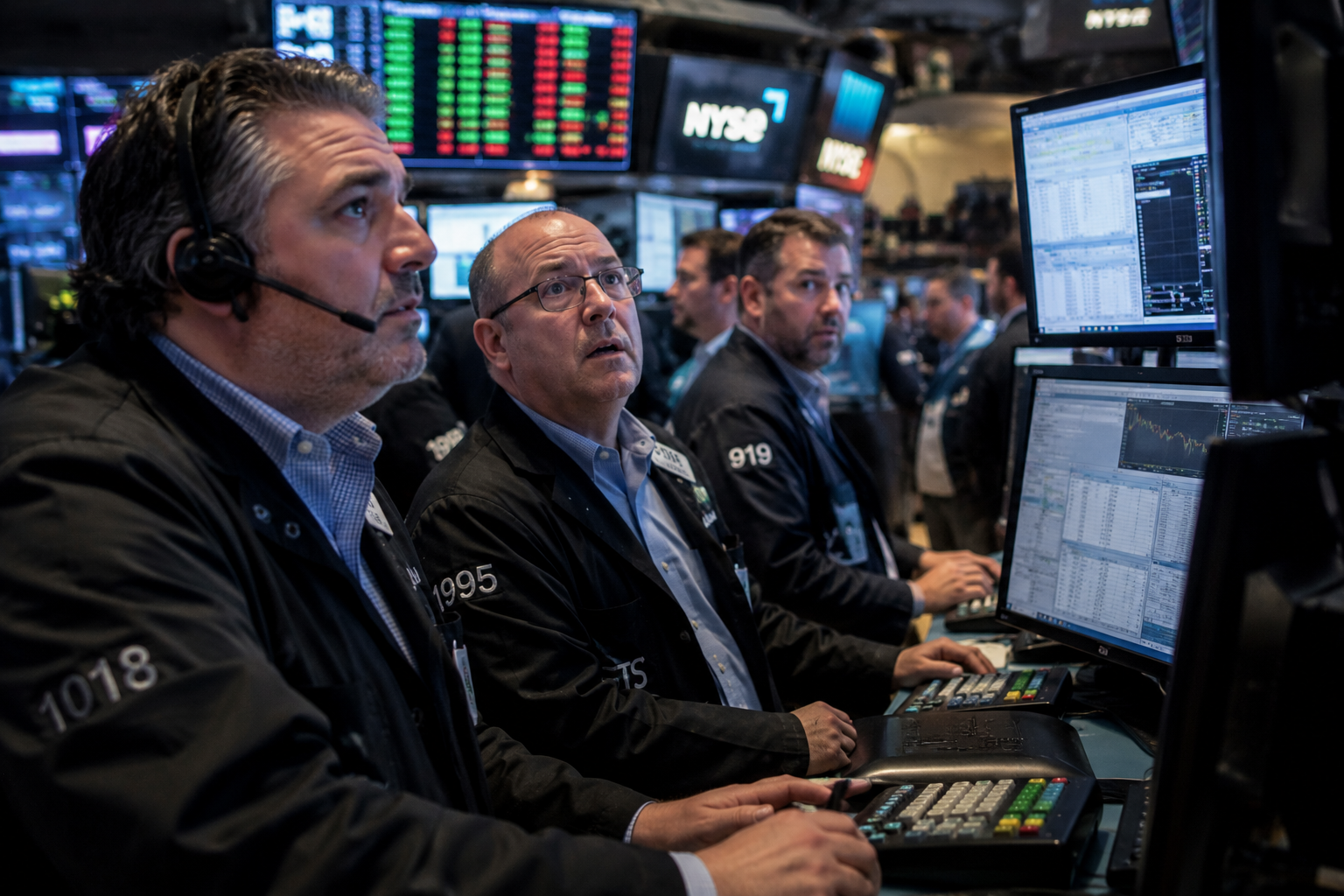
US equities remain remarkably resilient, even as a standoff between the United States and Iran over the Strait of Hormuz continues.
The S&P 500 gained more than 16% across April and May, a feat achieved only four other times since World War II, according to Deutsche Bank Research.
The rally has also been fuelled by renewed enthusiasm around artificial intelligence after the latest earnings season convinced many investors that technology stocks still have room to run despite their substantial gains in recent years.
Analysts largely share that view.
In its 2026 Mid-Year Outlook, JPMorgan said that while the conflict in the Middle East dominated market attention during the first half of the year, artificial intelligence is likely to emerge as the more durable driver of investment returns over the years ahead.
Against this backdrop, Invezz spoke with Robert Hackel, Chief Operating Officer of RF Lafferty, a New York-headquartered full-service broker-dealer that provides retail brokerage, wealth management, institutional sales and trading, among other services, to gauge investor sentiment.
Hackel shared his views on potential safe-haven assets if disruptions around the Strait of Hormuz persist, whether South Korean and Taiwanese equities have further room to rally, and where investors who may have missed the initial AI-driven surge could still find opportunities.
Excerpts:
Invezz: How are the current macroeconomic conditions, including the geopolitical disturbances related to the Iran war, rising oil prices, and the AI trade, reshaping business for you at RF Lafferty?
When volatility increases in the short term, either geopolitically or with commodity disruptions, you do see a temporary slowdown in investments as clients reassess portfolios and reduce risk.
This time has been similar to previous events, and we should see a pickup in business as those risks and binary events become clearer.
From a market perspective, the one thing the markets have never liked is simple: the unknown.
That is always difficult to plan for and tends to put both retail and institutional investors into a “pens down” mode where they wait for more clarity.
US stocks’ resilience and safe havens if Hormuz stays shut
Invezz: US equities have remained surprisingly resilient despite the Iran conflict and elevated oil prices. Do you think markets are underpricing the risks? What sectors become the safest havens if the Hormuz disruption persists longer than investors expect?
US markets have been extremely resilient for a considerable period of time, and that appears to be no different this time.
The Iran conflict is not being viewed as a long-term war.
President Trump has made it clear that there does not seem to be a “boots on the ground” engagement, and the conflict has paused following the ceasefire, which has continued beyond the original two-week period.
This has given the markets the belief that this will be a limited scope event, even though the disruptions themselves for oil and commodities have been significant.
Areas considered safe havens are REITs, and the large capital financial sector also seems secure.
How are clients’ portfolios responding to the increase in geopolitical risks?
Invezz: What changes are you making in client portfolios in response to the recent surge in geopolitical risk? Are high-net-worth clients moving more money into cash, Treasuries, gold, or defensive equities right now?
The current atmosphere surrounding AI and AI-related companies continues to push the markets higher due to their overall weighting in large indexes such as the S&P 500 and Nasdaq.
We also discuss with high-net-worth clients the need to be diversified and to have exposure across numerous asset classes, which is more important now than ever.
We are looking at defensive names as well as dividend stocks as places to put capital to work while taking a more defensive posture.
Do Korean and Taiwanese equities powered by AI boom have more room to run?
Invezz: What are the foreign stocks and bonds you are integrating into your clients’ portfolios based on current conditions? The Kospi has seen a great run this year, as have Taiwanese equities, but questions are also emerging about their rallies being led by
a few AI winners and equities being overbought. Are you bullish on them, and do you see more room to run?
The run in the semiconductor sector is one of the largest we have ever seen.
The Kospi and Taiwan equities are tied heavily to this sector and have had significant increases in value.
We believe they have great prospects, as many of the companies are in the business of making the blocking and tackling products necessary to power the move to AI.
The issue really is how much additional growth there can be from here.
We have been buying ASML, which is a semiconductor equipment manufacturer out of the Netherlands.
Demand for mega-IPOs is guaranteed
Invezz: Some big-ticket IPOs are on the horizon in June and the second half of 2026, like SpaceX, OpenAI, Anthropic, etc. Recently, Cerebras set the tone with overwhelming interest in its shares. Do you think investors would seriously assess revenue and profitability before parking their money, say in OpenAI, or are they becoming too tolerant of companies in AI and tech IPOs?
The large-cap IPOs on deck for the back half of the year are being discussed so much that the demand is as high as it has ever been.
We have received numerous phone calls from investors asking what our availability would be in the names, and it seems that everyone is looking to participate.
The S-1s that are being filed are for interesting and well-known companies.
People are finally having the opportunity to look under the hood to learn more about the actual business workings and financials.
I believe that demand will continue until some of them open flat or down.
SpaceX IPO may trigger a short-term pop on pent-up demand
Invezz: Similarly, the SpaceX IPO is raising concerns that the steep valuation of $1.75 trillion will leave little room for post-IPO runs and hence will eventually underperform the broader market. What are your thoughts, and will you advise your clients to go for the IPO?
While it’s hard to know for sure, I believe we will see a short-term pop following the offering.
There has been pent-up demand for the company, and there is expected to be significant coverage for several weeks after the IPO.
This will create a buzz that could be one of the largest we have seen.
Underappreciated opportunities for those late to the AI rally
Invezz: Many investors worry they are late to the AI rally. Where do you still see underappreciated opportunities, and what are your AI trade recommendations?
It is true that we are not in the early innings of the rally, but there are still some underappreciated opportunities and areas to invest in.
The amount of revenue that will be generated, and the ability to compare it to what investors previously expected for revenue and income, are still a few years away.
Risks include the data center buildouts, political risk from Congress related to rising energy costs for homeowners, and the ability to continue raising capital in the equity and debt markets.
We tend to look toward the corporate buildout area as a place to continue investing, including Dell Technologies (DELL), Hewlett Packard Enterprises, and ASML, along with energy companies NextEra Energy and Constellation Energy.
We are also looking at Honeywell, which stated in its 2025 Annual Report that AI has moved to the center of its strategy and that the company is breaking into three separate businesses.
That worked well for General Electric a few years back, and we hope that will play out again with Honeywell.
Why you should include UPS, Target, General Mills in your portfolios
Invezz: What is your outlook for the second half of 2026? Also, if you were constructing a ‘sleep well at night’ portfolio for the next five years, what would it look like?
We will continue to trade higher as the Iran conflict draws to a hopeful close and interest rates move lower or begin to plateau.
If building a “sleep well at night” portfolio, I would look at some large-cap names in undervalued areas with higher dividends, such as UPS, Target, and packaged food companies such as General Mills, as well as Pfizer, which offers a very high dividend.
The post Interview: RF Lafferty’s Robert Hackel says Dell, HPE among top hidden AI plays appeared first on Invezz