
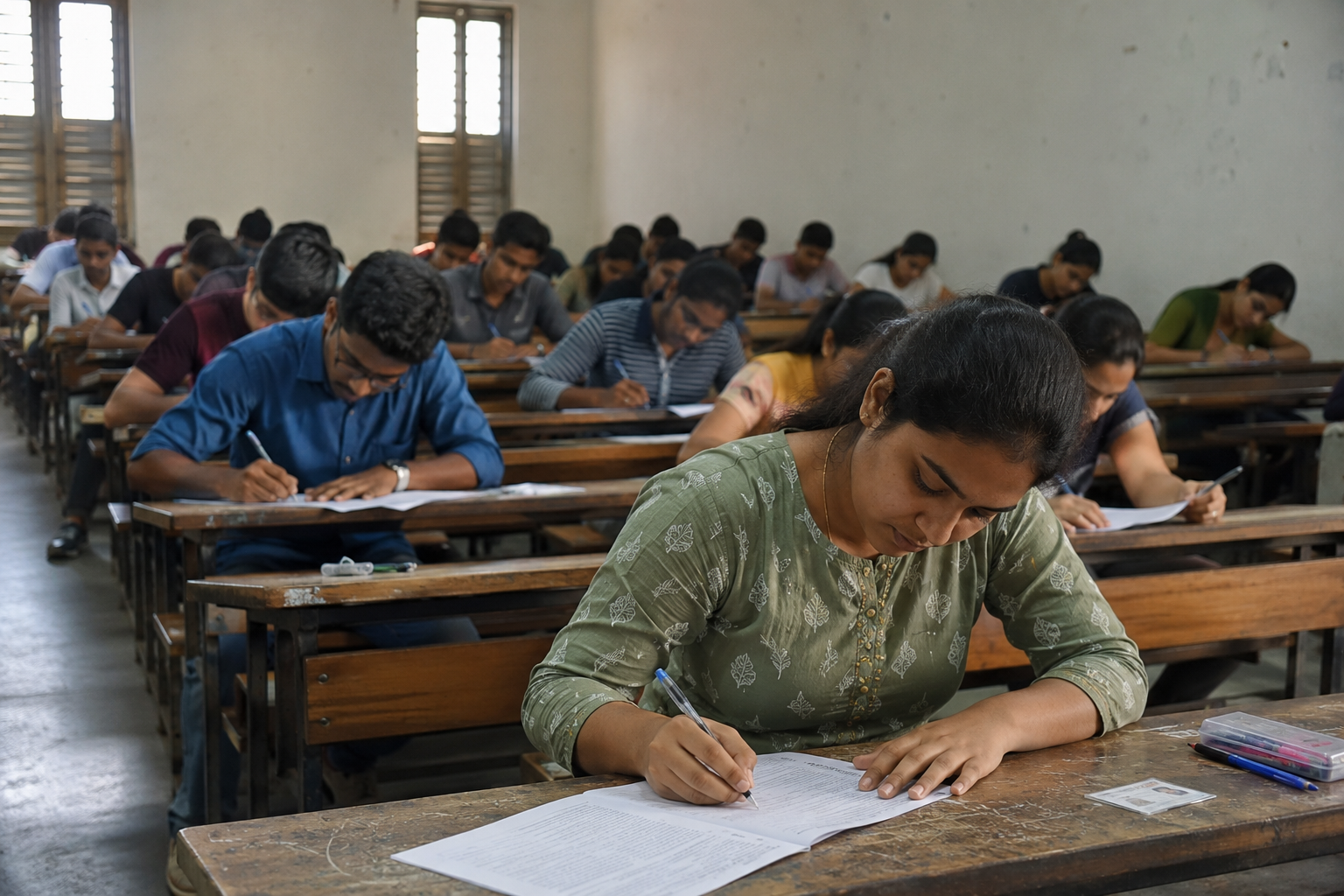
Across India, newspaper front pages this month were filled with smiling teenagers holding bouquets and victory placards.
Coaching institutes splashed photographs of medical entrance exam toppers across full-page advertisements, each claiming another record year of selections and top ranks.
For an industry estimated to be worth billions of dollars, the release of entrance examination results is more than an academic milestone.
It is the country’s biggest annual marketing campaign, selling millions of families the promise that the right coaching can turn ambition into admission.
Yet, beyond the celebratory advertisements, a starkly different image came to define India’s examination system this summer.
Thousands of students took to the streets demanding accountability over examination paper leaks, delayed recruitment processes, and repeated irregularities.
Protests in New Delhi and other cities at times turned violent, with police using tear gas, batons, and detentions to disperse demonstrators, drawing criticism from opposition leaders and human rights groups, who accused authorities of using excessive force against largely peaceful protesters.
The demonstrations eventually forced a political response.
Education Minister Dharmendra Pradhan resigned after weeks of mounting pressure, while the government announced a series of reforms aimed at restoring confidence in the examination system.
The contrast captures a deeper reality behind India’s booming coaching industry.
What has grown into a multi-billion-dollar business built on the promise of academic success now exists alongside a generation of students increasingly questioning not only the cost of chasing those dreams, but also whether the examination system itself remains fair.
The business of dreams
India’s coaching industry has grown into one of the world’s largest private education markets.
Market research firm IMARC Group estimates the sector was worth $7.2 billion in 2025 and projects it will more than double to $17.8 billion by 2034.
The industry thrives because access to India’s most coveted colleges and government jobs is funnelled through a handful of fiercely competitive entrance examinations.
For example, NEET is the sole gateway to undergraduate medical education in India, where millions of candidates compete for fewer than 150,000 seats each year.
Similarly, around 1.3 million students register annually for JEE Main, competing for roughly 18,000 seats at the prestigious Indian Institutes of Technology.
Only around 5% to 6% of NEET candidates ultimately secure a medical seat, a success rate that explains why coaching has become not just an option, but a default for many families.
Preparing for those examinations often requires a substantial financial commitment.
Fee schedules published by major coaching providers show that flagship classroom programmes typically cost between ₹150,000 (approx. $1,596.05) and ₹220,000 (approx. $2,340.87) a year before accommodation and living expenses.
Students relocating to coaching hubs such as Kota can spend well over ₹300,000 (approx. $3,192.10) annually, while online alternatives are considerably cheaper.
| Expense Type | Offline Classroom | Online Program |
|---|---|---|
| Annual Tuition | ₹1.20 lakh – ₹2.50 lakh ($1,430 – $2,975) | ₹30,000 – ₹1.00 lakh ($350 – $1,190) |
| Study Materials | Included (or ₹5,000 extra) | Included digitally |
| Test Series | Included | ₹2,000 – ₹10,000 |
| Hostel & Mess (Kota/Hubs) | ₹1.44 lakh+ ($1,715) | ₹0 (From home) |
The financial commitment is reflected in official data.
A government survey from 2025 found that 27% of students in India take private coaching, with the share rising to 30.7% in cities versus 25.5% in villages.
Urban households spent an average of ₹3,988 per child annually on coaching, more than double the rural average of ₹1,793, and costs rose to ₹9,950 at the higher-secondary level in cities.
| Metric | Urban | Rural |
|---|---|---|
| Students taking coaching | 30.7% | 25.5% |
| Average coaching spend | ₹3,988 | ₹1,793 |
| Higher secondary coaching spend | ₹9,950 | ₹4,548 |
In other words, what was once considered an “extra” layer of preparation has become part of the education budget for millions of Indian families.
That money is often paid in the hope that coaching can provide certainty in a system that offers very little.
Despite the criticism surrounding the industry, none of the students interviewed argued that coaching itself was unnecessary.
Most described it as an almost unavoidable response to an intensely competitive examination system, offering structured preparation, regular testing, and academic discipline that many believe schools alone cannot provide.
That is the background against which students describe their own experiences.
Kshitij Raj said he joined JEE coaching because preparing alone felt difficult.
He wanted, in his words, “proper guidance, experienced teachers, regular practice, and a disciplined study routine.”
Another student, Anant Raj, who is taking a drop year, said he felt coaching was necessary because “it is advised or being told by everyone” that admission to a coaching institute helps students crack IIT-JEE.
Vertika Vaishwi, who appeared for the JEE exam for the first time this year, said her family spent about ₹500,000 (approx. $5,320.17) on tuition fees and another ₹70,000 (approx. $744.82) to ₹80,000 (approx. $851.23) on other expenses.
“If I failed, it felt like my career would be over,” she added.
The price of preparation
The money is only one part of the burden. Students repeatedly described the emotional cost of staying in the race.
Kshitij said large batch sizes meant there was little individual attention when he had doubts.
Anant Raj echoed that concern, saying “individual attention was limited” because of the size of classes and that students who struggled often had to rely on self-study or online resources.
Sneha, who prepared for NEET, said coaching could be useful, but that success ultimately depended on the student’s own discipline and consistency.
The 19-year-old who dreams of becoming a doctor someday said that coaching institutes should also provide “mental health support and have mentors or teachers who can guide students personally and build their confidence.”
Vaishwi described a different frustration, saying her institute separated “studious” students from average performers and concentrated its attention on the top group, leaving others behind.
That disconnect between what is promised and what is delivered is also central to how students view the industry.
Kshitij said the institute promised personal attention and continuous mentoring, but large classes meant that this did not fully materialise.
Anant made the same point more sharply: advertisements and counselling sessions highlighted top ranks and personalised support, but real mentoring was often limited.
As 20-year-old NEET aspirant Mohammed Farhan Akhtar put it, “advertisements often create unrealistic expectations about guaranteed success.”
India’s consumer watchdog has also taken notice.
In May, the Central Consumer Protection Authority said it had issued more than 60 notices and imposed penalties exceeding ₹1.39 crore on 31 coaching institutes over misleading advertisements and unfair trade practices.
The regulator said some institutes promoted successful candidates without clearly disclosing whether they had enrolled in full-time classroom programmes, online courses, crash courses or only test series.
From coaching halls to the streets
That uncertainty eventually spilled beyond coaching classrooms and into the streets.
The immediate trigger for the protests was the cancellation of NEET after question papers were found to have been leaked.
About two million students took the examination before the results were scrapped, and a retest was ordered.
The controversy struck a system where millions compete for a limited number of university seats and where repeated leaks in recruitment and entrance examinations had already eroded confidence among young Indians.
The demonstrations quickly escalated into one of the biggest youth-led protests faced by Prime Minister Narendra Modi’s government.
Thousands gathered in New Delhi and other cities, with clashes between protesters and police leaving scores injured.
Authorities shut metro stations, suspended mobile internet in parts of the capital, and imposed extensive security measures.
The political pressure ultimately forced a government response.
Education Minister Dharmendra Pradhan resigned, while the government announced tougher measures against paper leaks, proposed special courts to prosecute offenders, and unveiled broader reforms, including a task force to strengthen the integrity of the examination system.
For many students, however, the issue extends beyond a single leak or a single minister.
The same system that asks students to pay more, study longer, and endure greater stress is also one that many now believe they can no longer fully trust.
The post Inside India’s coaching boom and the crisis of confidence in its exam system appeared first on Invezz