
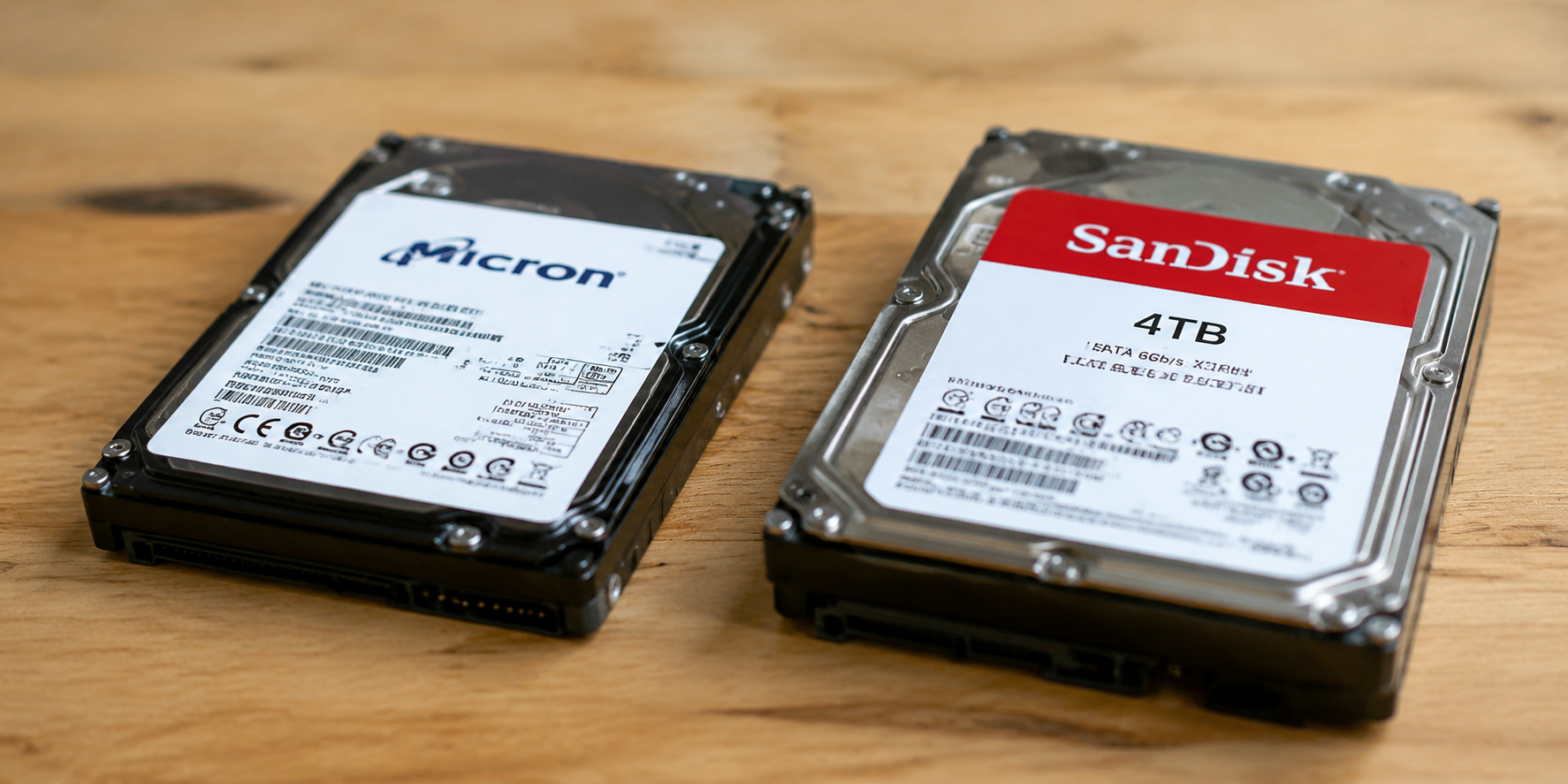
Micron and SanDisk shares rebounded in the early premarket trading on Monday after a bruising semiconductor sell-off forced investors to reassess one of the most crowded parts of the artificial intelligence trade.
At 5:45 am ET, Micron (NASDAQ: MU) was up more than 3%, while SanDisk (NASDAQ: SNDK) had gained about 2.5%, according to market data, as investors attempted to buy the dip following last week’s sharp sell-off.
The reversal captures the debate confronting memory investors: did last week’s rout create an attractive entry point, or is the market beginning to anticipate the next downturn in a notoriously cyclical industry?
Micron, SanDisk stock: A brutal sell-off invited dip buyers
The rebound followed a punishing week for AI hardware as the Philadelphia Semiconductor Index dropped 1.6% on Friday and entered a bear market after falling more than 20% from its June peak.
Micron ended the week roughly 30% below its June record, while SanDisk had retreated more than 28% from its June 25 high.
SanDisk stock rose by more than 600% in 2026, underscoring how far expectations and valuations had run before the correction.
That reset encouraged traders to revisit companies still benefiting from constrained supply and rising prices.
JPMorgan cross-asset strategist Fabio Bassi described the chip decline as a temporary “wobble”, rather than the end of the AI rally, in comments reported by The Wall Street Journal.
Bassi said memory stocks had become highly concentrated positions, allowing small changes in sentiment to produce unusually large moves.
Demand for the computing capacity required by AI, however, remained strong.
That helps explain why Monday’s buyers emerged quickly, even though the broader valuation and spending concerns behind Friday’s rout had not disappeared.
Shortages keep the bullish case alive
The fundamental argument has not disappeared.
KeyBanc analyst John Vinh said “memory shortages remain persistent” after supply-chain checks in Asia. Vinh expects tight conditions through 2027.
KeyBanc forecasts DRAM prices will rise 15% to 20% sequentially in the third quarter and another 15% in the fourth. NAND prices could jump 30% to 40% this quarter, followed by another 15% increase.
Micron is heavily exposed to DRAM and high-bandwidth memory used alongside AI accelerators.
SanDisk is centred on NAND flash and enterprise solid-state drives, which store and retrieve the datasets used in AI workloads.
Evercore ISI analyst Amit Daryanani told clients that SanDisk’s long-term customer agreements were creating a “new memory paradigm.”
Those contracts improve visibility into revenue, earnings and cash flow while clean-room capacity remains constrained.
The boom is creating its own risk
The same shortage supporting prices is encouraging enormous investment.
Samsung and SK Hynix have outlined hundreds of billions of dollars in new manufacturing projects, while Micron recently raised its planned United States investment to more than $250 billion through 2035.
That spending will take years to affect output, but it revives memories of previous cycles when shortages triggered overbuilding and falling prices.
China’s ChangXin Memory Technologies is another concern.
Morgan Stanley estimates China could provide about 30% of net DRAM wafer additions through 2028.
Higher memory prices may also become self-defeating.
Costlier DRAM, HBM and NAND raise the expense of AI infrastructure, increasing pressure on hyperscalers already being asked to prove returns on huge capital budgets.
The post Micron stock up 3%, SanDisk gains 2.5%: what woke the memory trade? appeared first on Invezz