
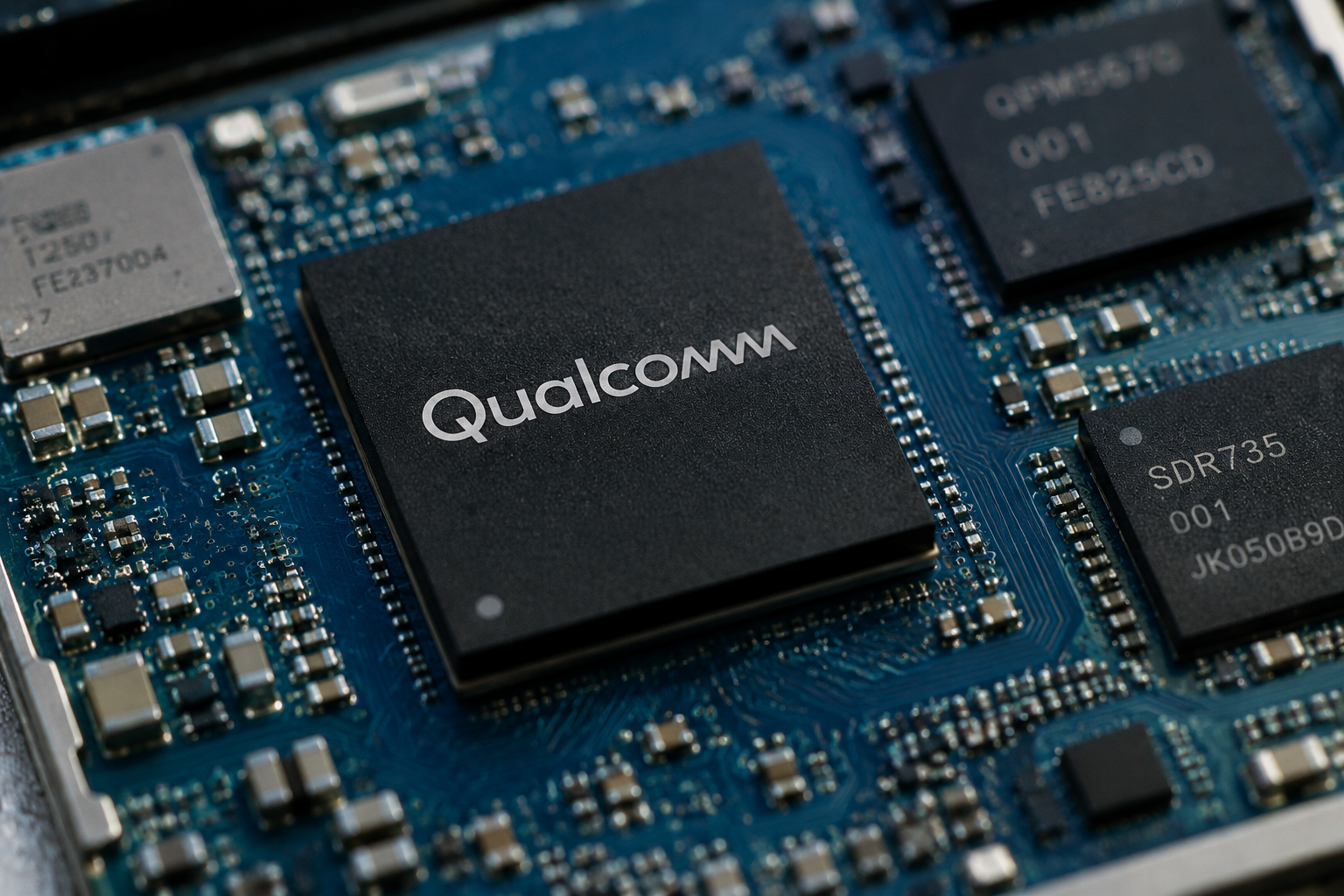
Qualcomm has set out an ambitious growth target for its data centre business, forecasting $15 billion in sales from the segment by 2029 as it accelerates efforts to diversify beyond its core smartphone chip business.
The company said that, alongside a broader expansion of its artificial intelligence strategy, it helped lift its shares more than 12% in after-hours trading on Wednesday.
At an investor presentation, Qualcomm Chief Financial Officer Akash Palkhiwala stated that the company anticipates its data centre business to generate $5 billion in revenue in fiscal 2027.
QCOM also raised its outlook for revenue from chips outside its traditional smartphone business.
The company now expects this segment to bring in $40 billion by 2029, up from an earlier estimate of $22 billion.
“We will be truly diversified,” Palkhiwala said.
The upbeat outlook also lifted shares of Arm Holdings, which provides underlying technology for many Qualcomm chips.
Arm rose 5% after Qualcomm’s forecast.
AI and hyperscaler push gathers pace
Earlier in the day, Qualcomm said Microsoft and Meta Platforms will use its new AI chips.
The company also said it will make custom chips for two other unnamed hyperscalers.
The announcements mark a significant step in Qualcomm’s effort to establish itself in the fast-growing AI infrastructure market, where chipmakers are racing to secure a role in data centres and large-scale computing systems.
Qualcomm’s pivot towards AI chips comes as the smartphone market faces increasing pressure.
The company said the market has been squeezed by a memory chip shortage driven by surging demand for AI infrastructure.
At the same time, major customers such as Apple and Samsung are developing more chips in-house, adding to the pressure on Qualcomm’s traditional business.
Bank of America analysts had earlier estimated that Qualcomm’s data centre push could generate modest annual revenue of roughly $2 billion to $5 billion by fiscal 2027 to 2028.
Qualcomm’s new target points to a more aggressive expansion plan.
Modular acquisition strengthens software strategy
Alongside its revenue targets, Qualcomm announced that it has reached an agreement to acquire Modular Inc., in a move aimed at strengthening Qualcomm Technologies’ software capabilities for generative and agentic AI across both data centre and edge environments.
The company said the acquisition is designed to deepen the software foundation behind its data centre strategy, with a focus on improving inference, orchestration, and deployment in distributed AI systems.
Qualcomm said Modular provides an open, AI-native software stack that allows AI models to run efficiently across a range of hardware architectures, including CPU, GPU, NPU, and custom ASIC systems, without requiring developers to rewrite software for each accelerator.
According to Qualcomm, the acquisition will help connect system-level optimisation with increasingly heterogeneous and disaggregated computing environments, an area that is becoming more important as AI workloads scale and performance-per-watt becomes a critical factor in inference costs.
By combining Qualcomm Technologies’ chip capabilities with Modular’s software platform, the company said it aims to offer customers a more efficient AI compute layer spanning devices, edge systems, and cloud infrastructure.
“This acquisition marks a pivotal moment not just for Qualcomm, but for the AI industry,” said Cristiano Amon, President and CEO of Qualcomm Incorporated.
He said the industry is shifting towards “disaggregated, multi-vendor architectures” that require “a more open and modern software foundation.”
Modular Co-founder and CEO Chris Lattner said the deal would help advance the company’s mission of building a more open and efficient software foundation for AI.
“Joining Qualcomm gives us the scale and platform reach to accelerate that mission,” he said.
Broader bet beyond smartphones
Qualcomm’s revenue targets and the Modular acquisition underline a broader strategic shift.
The company is positioning itself not only as a supplier of smartphone processors, but also as a provider of AI chips, custom silicon, and software infrastructure across data centre and edge computing markets.
The transaction is expected to close in the second half of 2026, subject to customary closing conditions and regulatory approvals.
The post Qualcomm wants $15 billion from data centres as phone-chip era shifts appeared first on Invezz