
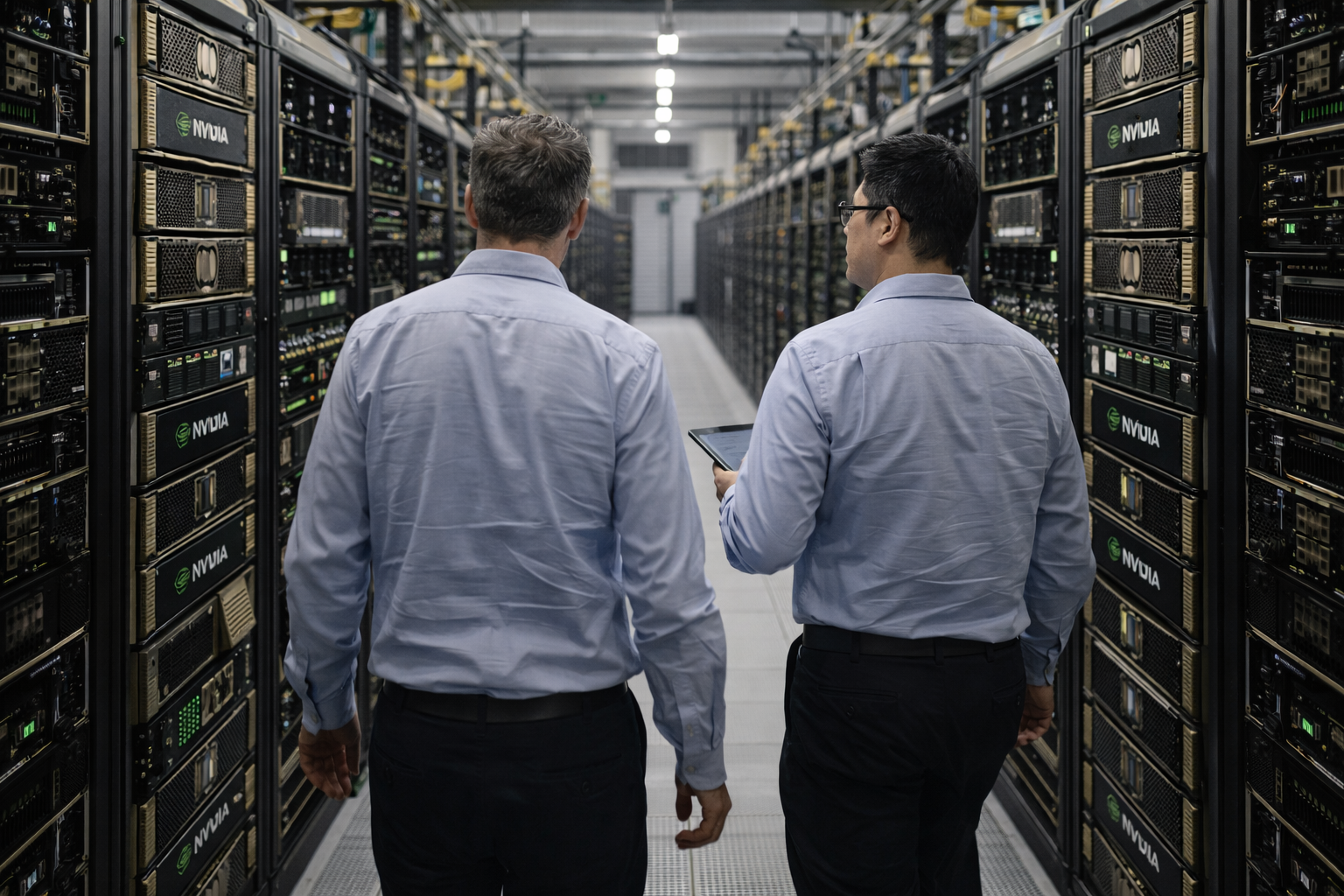
Nvidia has deepened its South Korea push with a series of deals that show how central the country has become to the next phase of the AI boom.
The agreements, announced during Jensen Huang’s high-profile visit to Seoul, bring Nvidia closer to SK Hynix, SK Telecom, Naver, Doosan Group and LG Group.
The strategy seems ambitious as Nvidia is trying to secure advanced memory supply, expand demand for AI data centres, and position South Korea as a hub for “physical AI” across robots, factories and cloud infrastructure.
The deals came on the day South Korean markets are facing one of the worst routs, with the KOSPI index falling more than 8%.
SK Hynix gets deeper into Nvidia’s AI supply chain
SK Hynix is the clearest immediate winner from Nvidia’s Korea push.
The memory-chip maker signed a multi-year technology partnership with Nvidia to develop advanced memory for global AI data centres.
Huang said SK Hynix had been Nvidia’s largest memory partner and would continue to hold that role.
He also said Nvidia already buys “billions of dollars” from SK Hynix each year, and that this spending would grow substantially.
That matters because the AI trade depends heavily on high-bandwidth memory, not just graphics processors.
Nvidia designs the chips that power AI models, but those chips need fast, specialised memory to work efficiently in data centres.
SK Hynix has already become a key supplier in that market, helped by strong demand for HBM used in Nvidia’s AI systems.
Ryu Young-ho, senior analyst at NH Investment & Securities, said the SK Hynix-Nvidia partnership reinforced the view that memory chips were evolving from a commodity product into a more customer-specific business.
Naver and SK Telecom get an AI-factory roadmap
Nvidia’s Korea strategy is also about infrastructure as the company wants local partners to build the systems that train, run and commercialise AI models.
Naver plans to use Nvidia technology to expand its Gak Sejong data centre, starting with 55 megawatts by early 2027.
It then aims to grow capacity overseas toward the gigawatt scale.
For Naver, the deal could strengthen its cloud business, generative AI services, search products and sovereign AI ambitions.
The company is also joining Nvidia’s Nemotron Alliance to advance its HyperCLOVA X large language model.
SK Telecom gets a similar infrastructure route. The telecom operator will build a gigawatt-scale AI cloud in South Korea using Nvidia technology, with its first AI data centre expected to come online in 2027.
LG and Doosan show Nvidia’s Korea bet goes beyond chips
The LG and Doosan tie-ups show that Nvidia’s Korea strategy is not limited to memory and cloud.
Huang said Nvidia is working with LG Group on humanoid robots and future data-centre architecture.
The partnership includes motor technology and mechanical systems, which link directly to Huang’s broader view that robotics could become one of South Korea’s next major growth areas.
Korea has the manufacturing base, electronics expertise and industrial depth needed to turn physical AI into real products.
LG also gives Nvidia a route into the harder parts of AI infrastructure, as future data centres will need better cooling, power delivery and mechanical design as computing loads rise.
Doosan’s role is different but still strategic.
The company will use Nvidia technology and supply materials used in Nvidia’s high-performance Blackwell chips.
That places the industrial group closer to the physical supply chain behind AI hardware.
The market reaction shows why investors should separate the long-term story from the short-term trade. Korean chip stocks came under heavy pressure during the broader global tech selloff, even as Nvidia was announcing positive agreements in Seoul.
That suggests investors remain worried about stretched AI valuations and rate-sensitive growth stocks.
The post Nvidia’s 5 Korea deals explained: what SK Hynix, Naver and LG gain appeared first on Invezz