

Brent crude oil price remains in a narrow range this week as investors watch the new developments in the ongoing US-Iran crisis. It was trading at $95.40 today, June 5, after Hezbollah rejected the new ceasefire agreement between Israel and Lebanon.
Odds of new fighting rise as Hezbollah rejects ceasefire
Brent and the West Texas Intermediate have barely moved this week as investors assessed the current phase of the US-Iran crisis and the dwindling US Strategic Reserves.
Odds of a quick deal between the two sides have now dropped substantially this week as ceasefire talks stalled. Worse, the recent ray of hope between Israel and Lebanon found a major roadblock after Hezbollah rejected the ceasefire.
Hezbollah argued that the ceasefire was not in Lebanon’s interest and amounted to surrender. This means that the fighting between Hezbollah and Israel will continue in the foreseeable future, something that Israel wants.
The challenge, however, is that Iran has insisted that any deal with the US will be contigent on the developments in Lebanon.
Therefore, there is a real risk that the US and Iran will restart their bombing campaigns. Just this week, Iran launched a barrage of missiles towards Kuwait in response to US attacks on its targets.
A renewed phase of fighting would be risky for the world economy, as it would push crude oil prices much higher than where they are today. Besides, data show that US oil inventories have continued falling, while drawdowns from the Strategic Petroleum Reserves (SPR) have accelerated and moved to the lowest level in years. If this trend continues, chances are that these reserves wil run out in months.
US driving season is underway
At the same time, the US is now in its driving season,where petroleum demand is usually at its highest. As a result, some top officials and experts warn of an impending danger in the world’s oil market if the Strait of Hormuz continues its closure for longer.
Before the war, 20.3 million barrels of oil used to pass through the Strait of Hormuz each day. This figure has now been reduced to near zero by Iran’s closure and the US blockade.
The world has found some extra oil, with Saudi Arabia boosting its pipeline exports, surging to 7 million barrels per day. Oil exports from the US and other countries like Canada has soared. This, however, has not been enough to offset the losses from the Strait.
Brent crude oil price technical analysis
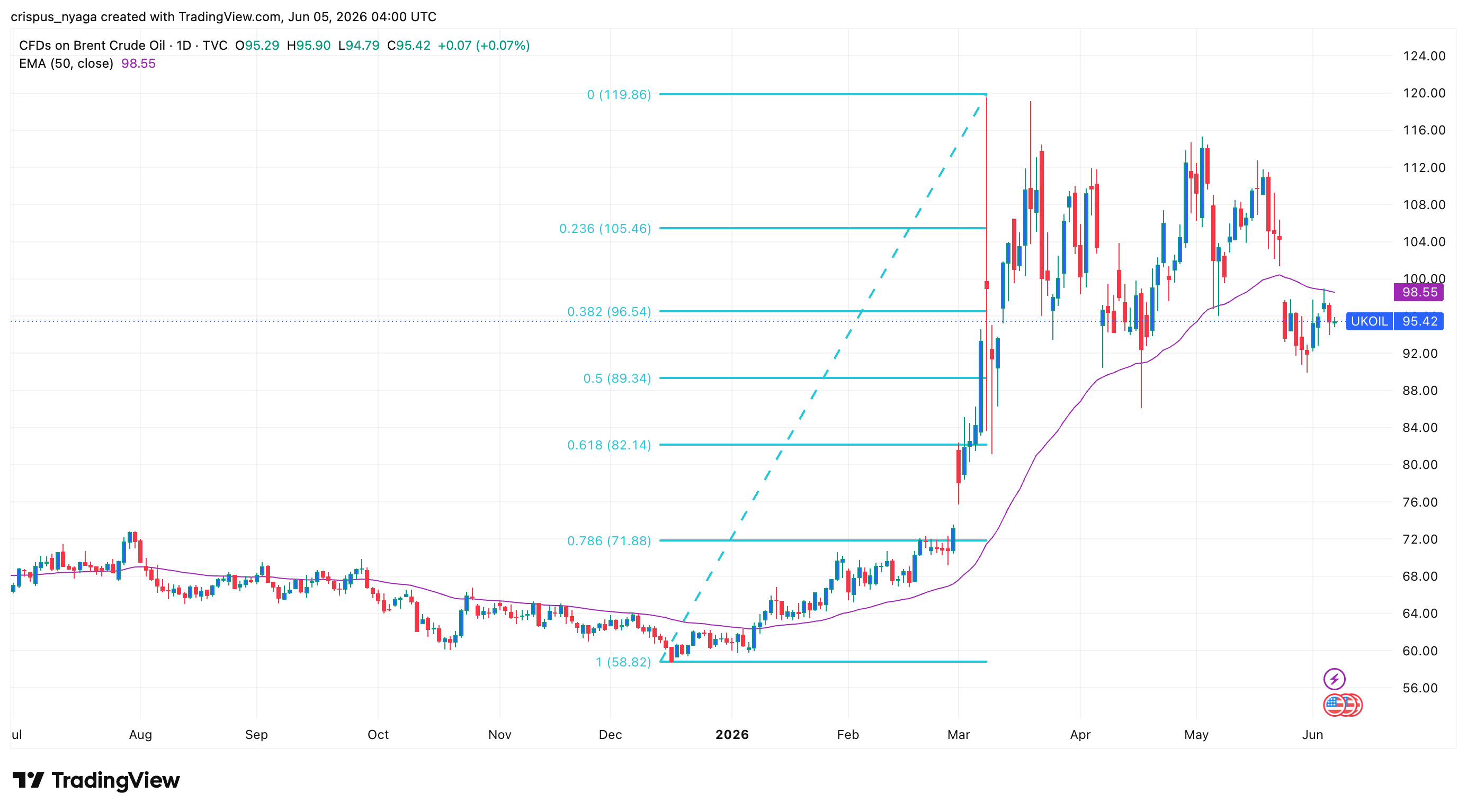
Brent crude oil price chart | Source: TradingView
The daily chart reveals that Brent crude oil price has been sending mixed signals in the past few weeks. On the one hand, it has moved below the 50-day Exponential Moving Average (EMA), a sign that bears remain in control.
Brent has also formed a double-top pattern, a common bearish reversal sign in technical analysis. If this happens, Brent may drop to the key support level at $60.
On the other hand, Brent has formed an island reversal pattern, which happens after a big down gap. If this happens, the price may rebound and move above the key resistance level at $100. Such a move may also push it to $110 and above.
The post Brent crude oil price forecast as the consolidation continues: will it rise or crash? appeared first on Invezz