
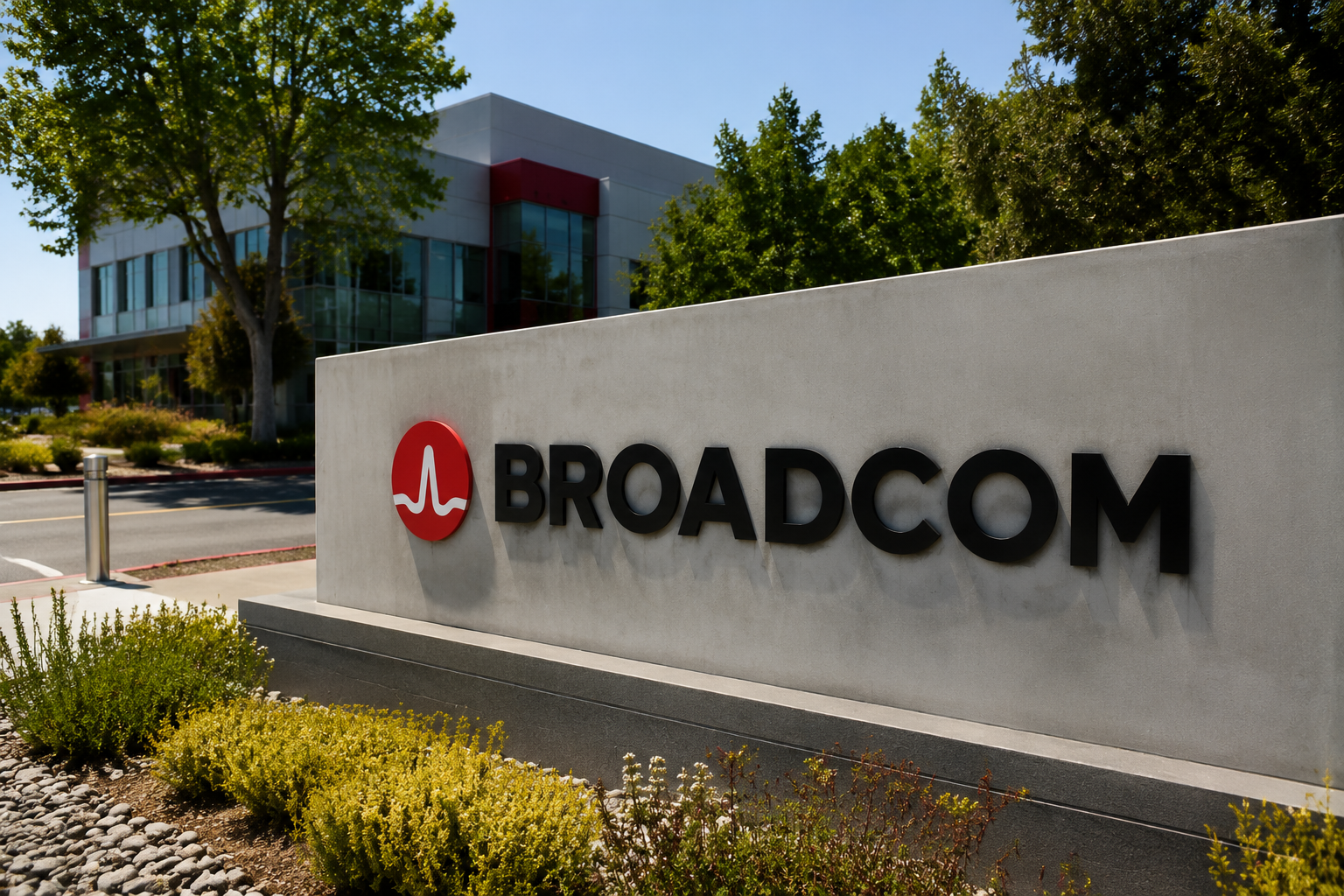
Broadcom delivered the kind of quarter most companies would call a statement result, but the market wanted more.
The chipmaker reported record revenue, record free cash flow and another sharp jump in artificial intelligence semiconductor sales.
Yet Broadcom stock (NASDAQ: AVGO) tumbled more than 13% in extended trading after the results, as investors focused less on what the company had already delivered and more on what it did not add.
For Wall Street analysts, that gap is exactly the point.
The sell-off looks less like a rejection of Broadcom’s business and more like a reset in a stock that had been priced for constant upside surprises.
Broadcom stock: Blowout quarter that market still punished
Broadcom’s fiscal second-quarter numbers were strong by almost any normal benchmark.
Revenue rose 48% from a year earlier to $22.2 billion, while adjusted earnings came in at $2.44 a share.
AI semiconductor revenue jumped 143% to $10.8 billion, driven by demand for custom AI accelerators and networking chips.
Free cash flow crossed $10 billion for the quarter, and management guided for third-quarter revenue of about $29.4 billion.
That should have been enough to support the bull case. Instead, the stock sold off sharply.
The problem was not the quarter itself. It was the absence of a new catalyst.
Chief Executive Hock Tan reiterated Broadcom’s long-term AI revenue target of more than $100 billion for 2027, but he did not raise it.
The company also did not announce a fresh marquee customer, even though investors have grown used to Broadcom’s AI story being pushed forward by hyperscaler deals.
For a stock that had rallied hard into earnings, “good” was not good enough.
Creative Strategies Chief Executive Ben Bajarin said that nothing in the earlier estimate had slowed down, but Broadcom simply “didn’t raise it”.
That sentence captured the market’s disappointment neatly as investors were not punishing a weak business, but a lack of fresh acceleration.
Why analysts are raising targets into the carnage
The more interesting reaction came from the sell side.
Jefferies analyst Blayne Curtis raised his Broadcom price target to $550 from $500 after the results and kept a Buy rating on the shares.
His move suggested that the post-earnings drop did not change the bigger thesis: Broadcom remains one of the clearest non-Nvidia ways to invest in the build-out of custom AI chips.
Wells Fargo had already lifted its target to $545 from $430 in May, citing stronger demand assumptions for Broadcom’s AI chip business.
Susquehanna’s Christopher Rolland also raised his target to $490 from $450 ahead of the results and kept a positive rating.
The message across these calls is not that valuation no longer matters, but analysts are separating two things: a richly valued stock that may have run too far too fast, and a business whose fundamentals are still improving.
Consensus data also remains heavily supportive as most analysts covering Broadcom stock continue to rate the shares at Buy or higher, with no Sell ratings in the mix.
That does not remove downside risk, but it shows that Wall Street sees the earnings reaction as a valuation correction rather than a broken AI story.
The post Why analysts are raising Broadcom targets despite a 14% stock plunge appeared first on Invezz