
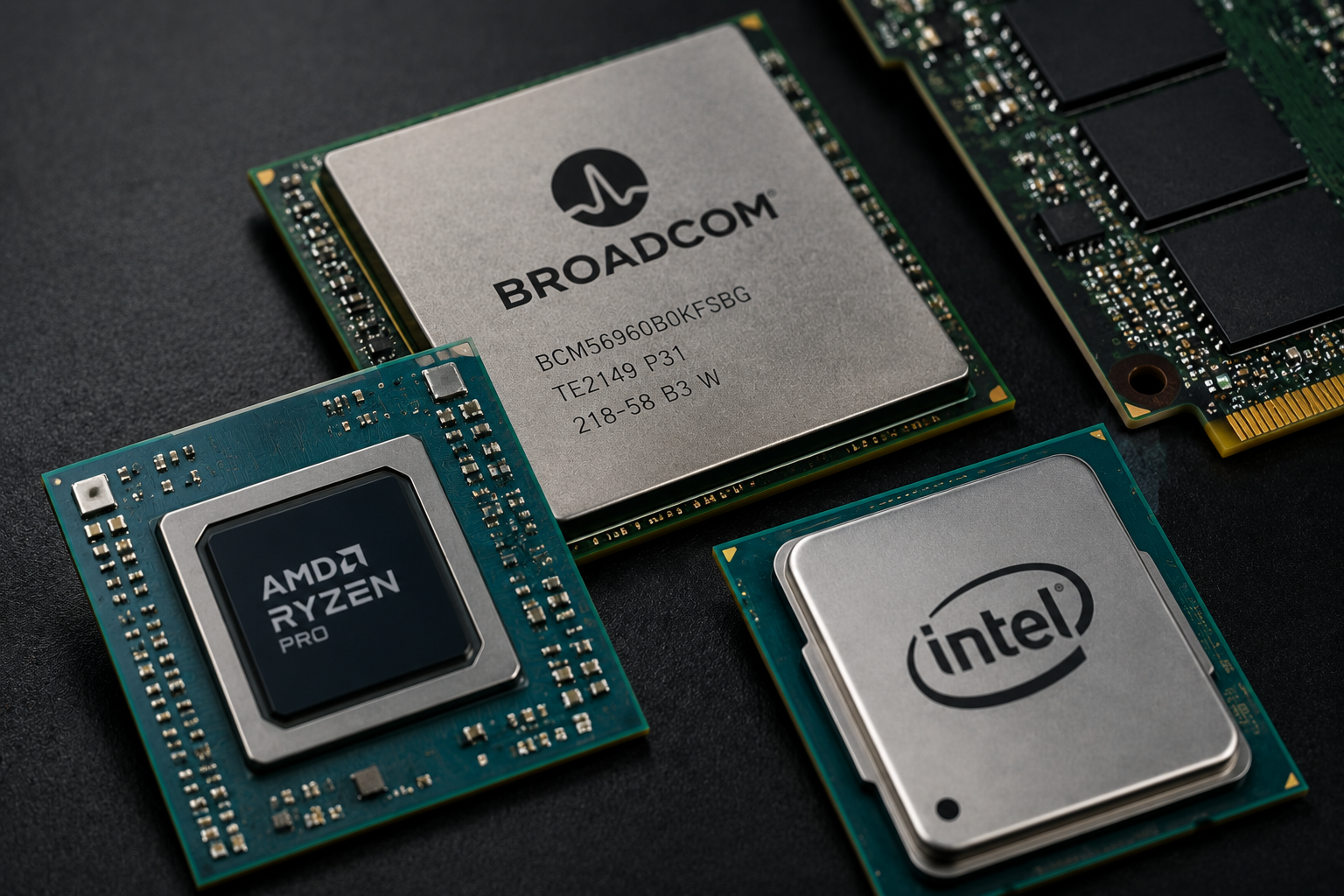
Technology stocks came under heavy pressure on Thursday after Broadcom’s latest outlook failed to satisfy investors who had been betting on an even faster acceleration in artificial intelligence-related demand.
Broadcom shares slumped 15%, putting the semiconductor giant on track to become the worst-performing stock in the S&P 500.
The decline quickly spread across the broader chip sector, triggering losses among companies that have been among the biggest beneficiaries of the AI investment boom.
The selloff reflects growing concerns that expectations for AI-driven growth may have run ahead of reality after a powerful rally in semiconductor stocks over recent months.
Memory-chip maker Micron Technology MU fell 9.4%, while networking and chip designer Marvell Technology dropped more than 6%.
Flash memory specialist Sandisk lost around 5%, and server manufacturer Super Micro Computer declined roughly 4%.
Elsewhere, Intel slid more than 4% and Advanced Micro Devices shed over 7% as investors rotated out of high-flying AI-linked names.
High expectations prove difficult to satisfy
The market’s reaction appeared less about Broadcom’s actual performance and more about the gap between expectations and reality.
Broadcom’s fiscal third-quarter guidance came in above Wall Street consensus forecasts, but analysts said investors had been hoping for a much stronger outlook after months of upward revisions tied to AI demand.
DA Davidson analyst Gil Luria said the company’s guidance failed to impress because many investors had already been pricing in a more aggressive acceleration in AI-related revenue.
One area that particularly disappointed investors was Broadcom’s forecast for AI semiconductor revenue, which came in approximately $400 million below market expectations.
Luria said the guidance likely reflected conservative forecasting and shipment timing rather than any deterioration in demand.
“The elevated expectations for Broadcom’s F2Q results were hard to live up to,” he said.
Susquehanna analysts pointed to another factor behind the softer outlook.
Broadcom confirmed that it would shift toward selling only chip solutions to customers rather than supplying broader rack systems.
The brokerage said it had already anticipated Broadcom would stop selling racks to Anthropic in fiscal 2026 and argued that the change largely explains the more moderate AI revenue guidance.
Despite the outlook, Susquehanna said underlying demand remained exceptionally strong, noting that AI semiconductor bookings exceeded $30 billion during the quarter.
Valuations come under scrutiny
Some analysts suggested the selloff was a natural consequence of soaring valuations across the semiconductor sector.
John Vinh, equity research analyst at KeyBanc Capital Markets, said investors were increasingly questioning whether earnings growth could continue matching the rapid rise in share prices.
“These stocks have all had very strong runs,” Vinh told CNBC.
He noted that repeated upgrades to earnings forecasts, particularly around AI demand, had pushed expectations significantly higher across the industry.
Broadcom’s sharp reversal may therefore represent a broader reset in investor sentiment rather than a judgment on the company’s fundamentals.
Adding to investor caution, Vinh noted that Broadcom has experienced some share loss at Google, one of its largest customers, as the technology giant increasingly diversifies its semiconductor supply chain.
Still, he maintained a positive long-term outlook on the stock.
“The near-term pull-back makes sense,” Vinh said.
Memory-chip cycle may be nearing a peak
Beyond Broadcom, investors are increasingly focused on another question hanging over the semiconductor sector: how much longer memory-chip prices can keep rising.
For much of the past year, Wall Street has expected the supply-demand imbalance supporting memory prices to persist until at least 2027.
HSBC strategists warned that slowing AI spending and declining chip prices rank among their biggest concerns for the sector.
Raymond James analyst Karl Ackerman believes the peak may arrive sooner.
“We expect DRAM and NAND average selling prices will peak in mid-CY26,” Ackerman wrote in a research note.
He expects both DRAM and NAND flash memory prices to begin recording sequential quarterly declines starting early next year.
Several factors could contribute to that shift.
On the supply side, Chinese memory manufacturers ChangXin Memory Technologies and Yangtze Memory Technologies are ramping up production capacity, potentially adding new supply to the market.
On the demand side, soaring memory prices are beginning to affect other industries that rely on chips.
Smartphone manufacturers, for example, are facing higher component costs, with Counterpoint Research forecasting a roughly 14% decline in global smartphone shipments this year.
The issue has become significant enough that nine US trade associations sent a joint letter this week to Treasury Secretary Scott Bessent and Commerce Secretary Howard Lutnick, urging action to address ongoing memory-chip shortages.
“While recent developments in AI offer the promise of generational technological advances and are important for US tech leadership, we must also ensure other key industries are not negatively impacted,” the letter said.
While a peak in memory pricing would traditionally signal the start of another downturn in the industry’s boom-and-bust cycle, Ackerman believes the impact may be less severe this time.
Long-term supply agreements between chipmakers and customers could help cushion the industry from a sharp correction, leading the analyst to maintain an Outperform rating on Micron despite growing concerns about the cycle.
For investors, however, Thursday’s selloff served as a reminder that even strong AI demand may not be enough to sustain semiconductor stocks when expectations become too difficult to exceed.
The post Broadcom rout hits Micron, AMD, others: AI demand, memory-chip cycle under focus appeared first on Invezz