
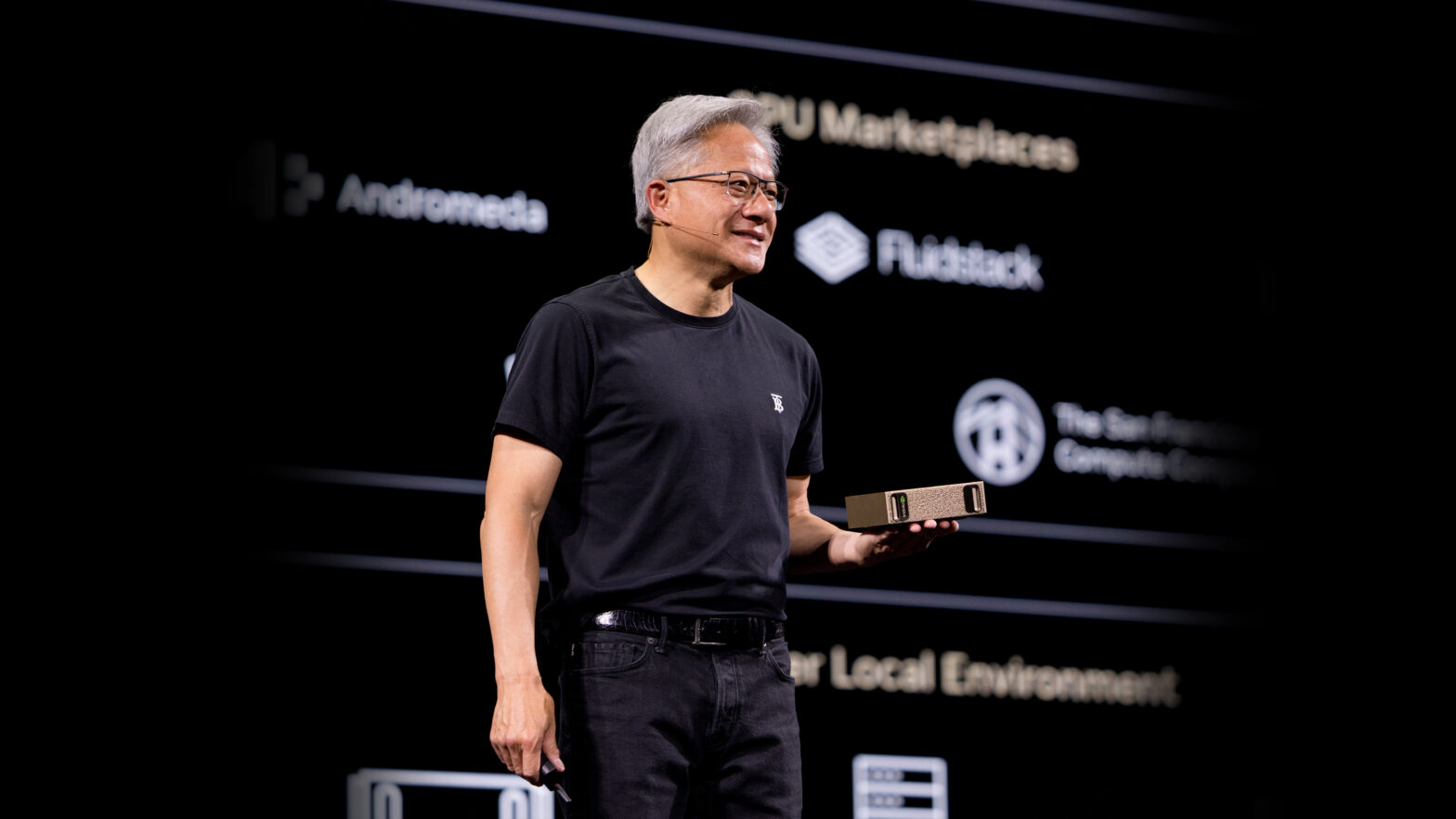
Nvidia Chief Executive Officer Jensen Huang said the company has secured enough supply to support strong growth in central and graphics processors, even as demand for artificial intelligence keeps the chipmaker under pressure to expand capacity.
Speaking during Computex week in Taipei on Tuesday, Huang said Nvidia had lined up supply for robust growth across its CPU and GPU systems.
The comments came a day after the company unveiled a new chip designed to bring AI capabilities directly to personal computers.
Nvidia stock (NASDAQ: NVDA) climbed sharply on Monday after the chip launch, outperforming the broader market.
The AI chip giant’s shares are now up 18.80% year-to-date, extending a rally driven by strong demand for artificial intelligence infrastructure.
Huang’s latest remarks underline both the scale of Nvidia’s opportunity and the limits still facing the AI supply chain.
The company remains the most important chip supplier to the AI boom, but Huang acknowledged that demand is still running ahead of available capacity.
Nvidia says supply is secured
“We’ve secured supply for very robust growth of all of those systems,” Huang said, referring to Nvidia’s CPUs and GPUs.
He added that the company had supply for “very, very robust growth”, while also saying Nvidia remained supply constrained.
That balance is central to Nvidia’s investment case. The company has become a barometer for AI demand because its processors power much of the infrastructure used to train and run large AI models.
Demand for its accelerators has generated tens of billions of dollars in revenue and made Nvidia one of the most closely watched companies in global markets.
For investors, Huang’s comments suggest Nvidia expects to keep expanding shipments even as customers continue to compete for access to its chips.
The supply constraint also signals that the AI infrastructure cycle remains intense, with demand still strong enough to absorb additional capacity.
RTX Spark targets AI PCs
Nvidia is also pushing beyond data centres and deeper into personal computers.
The company introduced the RTX Spark PC chip, which is expected to launch in the fall. Huang said the product is part of Nvidia’s work with Microsoft to “reinvent the PC” for the AI era.
The move expands Nvidia’s AI ambitions into a market long dominated by established processor companies.
By bringing AI features directly to PCs, Nvidia is positioning itself for a new wave of devices designed to run AI applications locally, rather than relying only on cloud-based infrastructure.
That strategy places the company in more direct competition with Advanced Micro Devices, Intel and Apple.
Each is seeking a larger role in AI-enabled computing as the technology moves from data centres into consumer and enterprise devices.
Vera CPU flagged as growth driver
Huang also highlighted Nvidia’s Vera data centre CPUs as a major part of the company’s next phase of growth.
“This is going to be our new major growth driver,” he said during a presentation on Nvidia’s latest AI products.
Huang said the Vera CPU could become even more popular than Nvidia’s GPUs because of its role in processing information.
That would mark a notable broadening of Nvidia’s business. The company is best known for GPUs, which have become essential to AI model training and inference.
CPUs, however, remain central to data centre architecture because they handle general processing tasks and support overall system performance.
Vera will compete with data centre chips from AMD and Intel. If Nvidia can gain traction in CPUs as well as GPUs, it could deepen its control over AI infrastructure and capture a larger share of spending by cloud providers and enterprise customers.
Taiwan remains central to strategy
Huang also reaffirmed Taiwan’s importance to Nvidia’s long-term plans.
The Nvidia CEO, who was born in Tainan, said last week that the company plans to invest about $150 billion a year in Taiwan, calling the island the epicentre of the AI revolution.
At the Taipei press conference, Huang described Taiwan as a strategic partner for the United States because of the island’s investments in US manufacturing.
He said Nvidia would continue investing in Taiwan while working to make its supply chain as resilient as possible.
“We are the largest purchaser of any company now for the ecosystem of Taiwan,” Huang said.
The comments highlight Nvidia’s reliance on Taiwan’s semiconductor ecosystem at a time when AI demand, supply-chain resilience and geopolitical risk are increasingly linked.
Taiwan remains central to advanced chip production and packaging, making it critical to Nvidia’s ability to meet customer demand.
AI demand keeps pressure on capacity
Nvidia’s update points to a company still operating in one of the strongest demand environments in the technology sector.
The chipmaker says it has secured supply for substantial growth, but Huang’s warning that constraints remain shows how difficult it is to scale production quickly enough for the AI boom.
That tension is likely to remain a key focus for investors.
The PC push through RTX Spark, the emphasis on Vera CPUs and continued investment in Taiwan all suggest Nvidia is trying to broaden its growth drivers beyond GPUs.
At the same time, the company is working to protect its position at the centre of the AI supply chain.
The bottom line is that Nvidia expects strong growth across CPUs and GPUs, is preparing to take AI deeper into PCs, and is betting that Taiwan will remain central to its expansion.
Supply remains tight, but Huang’s message was clear: demand is strong, capacity is expanding and Nvidia is moving to widen its lead.
The post Nvidia secures AI chip supply as Jensen Huang signals massive growth ahead appeared first on Invezz