

Brent crude oil price ended the week lower as investors anticipated an Iranian response to US proposals to end the ten-week war. It dropped to $100, down sharply from this month’s high of over $115 a barrel. Other global benchmarks like the West Texas Intermediate (WTI) and Russian urals have also retreated.
Iran is in no hurry to reach a deal
Brent crude oil price retreated after media reports suggested that a deal between Iran and the United States was imminent. Axios was the first major news organization to report this. In his report, Barack Ravid said that the two sides were working on a one-page document that would reopen the Strait of Hormuz.
The United States sent Iran a proposal on this deal late last week. In a press gaggle on Friday, Trump said that the US was waiting for Iranian’s proposal “tonight.” At press time, Iran was yet to submit the proposal, a sign that officials are not in a hurry.
Analysts believe that divisions between the US and Iran are extremely wide and hard to bridge. For one, the US will want Iran to hand it over the highly enriched uranium, which Trump will use to tout his success. Iran has largely ruled that out.
On the other hand, Iran will want an end to sanctions and the release of billions of dollars held in foreign accounts. Such a move will be risky for Trump, who has accused President Obama of shipping billions of dollars to Iran after the signing of the Iran nuclear deal.
Therefore, there is still a risk that the ongoing crisis will continue for longer than Trump expects. Such a move would lead to higher crude oil prices for longer.
In addition to the closure of the Hormuz Strait, the reality is that oil inventories are falling in some key countries. Data shows that global oil inventories fell by about 4.8 million barrels a day between March and late April.
Analysts believe that the oil supply shock will worsen even when the war ends because of the declining inventories. In a warning statement last week, Jeff Currie, a top analyst at Carlyle Group, said that US oil storage tanks may run empty around July 4th this year.
Looking ahead, signs of a potential deal between the US and Iran will be bearish for oil prices. Signs of an escalation, on the other hand, will lead to a reversal.
A key wildcard will be Donald Trump’s trip to China, where he will ask Beijing to press Iran to reopen the Strait of Hormuz. While the closure is affecting Beijing, chances are that Xi will not be interested in helping the US.
Brent crude oil price is sending mixed signals
Crude oil price chart | Source: TradingView
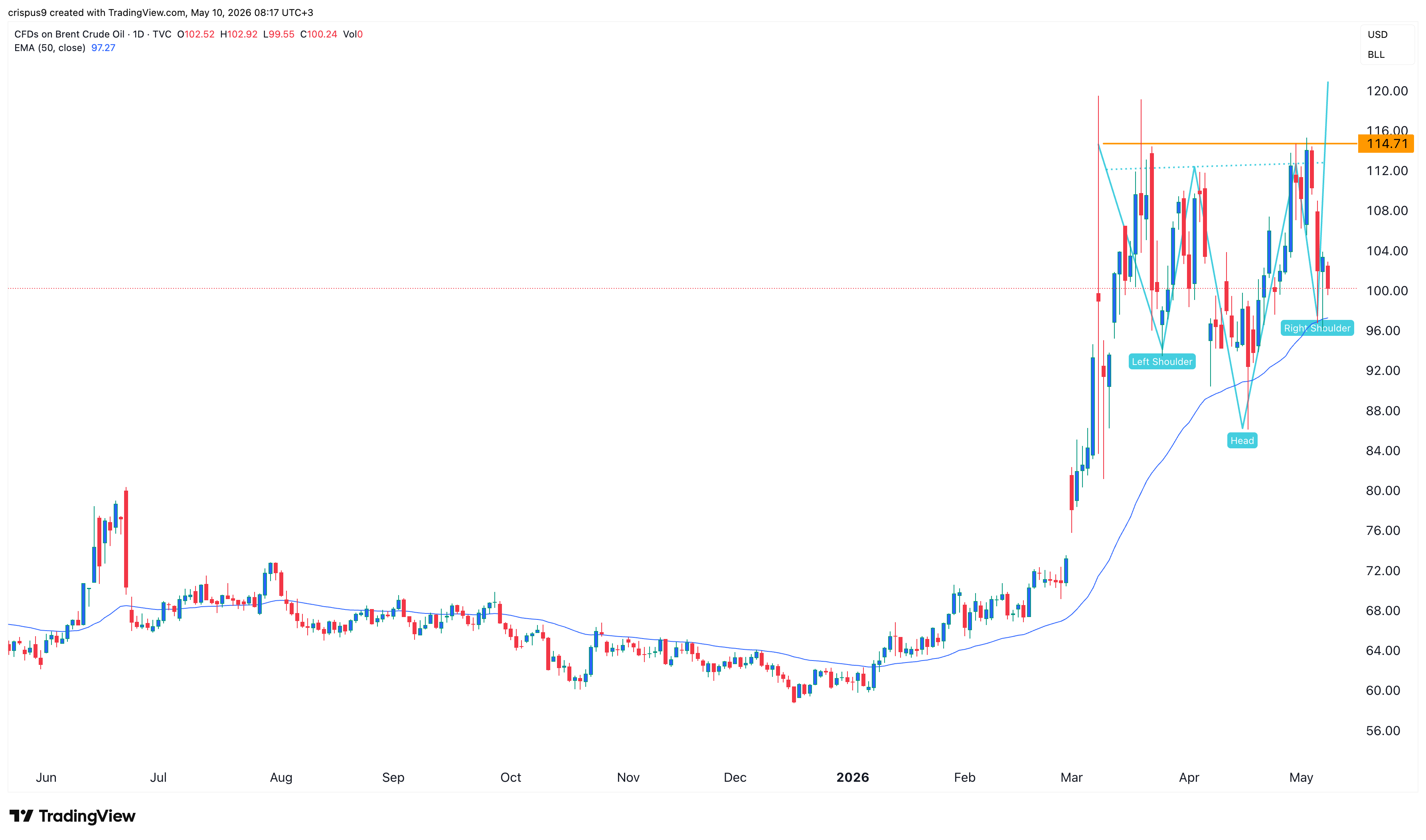
The daily chart reveals that Brent has come under pressure in the past few days. It has pulled back from $116 earlier this month to the current $100.
A closer look shows that it may have formed a double-top pattern whose neckline is at $85. However, one can also argue that it has formed an inverted head-and-shoulders pattern and is now in the right shoulder.
Therefore, this week will be crucial as traders wait for the outcome of the ongoing talks. The most likely scenario is where the inverted H&S pattern activates and retests the key resistance at $115. A drop below the support at $96 will invalidate the bearish outlook.
The post Brent crude oil forecast as Iran delays response to US Hormuz proposal appeared first on Invezz